When designing rockets for space travel, engineers must overcome the huge challenge of getting a vehicle out of our atmosphere. However, that’s only half the battle, as they also need to make sure the craft returns to Earth safely.
The landing is often the most challenging part, and the same is true of retirement planning.
While you might focus heavily on building your savings, you could overlook decumulation – the process of drawing from your retirement pot to generate an income and fund your lifestyle.
If you want to stick the landing, here are three factors to consider when designing your retirement income.
1. Your planned spending
First, consider the kind of lifestyle you will have in retirement because this dictates the level of income you’ll need.
For instance, if you plan to have a modest retirement and spend lots of time at home with family, you likely won’t spend as much as you would if you travelled the world and ate out every night.
That’s why a retirement budget is a good starting point. List all your regular expenses, including:
- Groceries
- Utility bills
- Travel costs
- Social spending
- Gifts for family and friends
This will give you a general idea of how much you need to draw from your retirement savings each year.
As well as your regular living expenses, you’ll need to factor in large one-off costs you might face throughout retirement.
This might include:
- Expensive bucket list trips
- A new car
- Home renovations
- Financial support for family members (house deposits, funding university, etc.).
If you fail to incorporate these costs into your income plan, you could deplete your retirement pot faster than expected when you make unplanned withdrawals from your savings.
You may also require later-life care if you face serious health issues and cannot live independently. According to Carehome.co.uk, the average weekly cost of residential care in the UK in 2026 is £1,298, or £1,535 if you need nursing care.
Depending on how long you spend in care, the bill could run into the tens or even hundreds of thousands.
While there may be some government support available, this is means-tested, and you will need to deplete your own assets first. Consequently, the cost of later-life care could significantly disrupt your plans and mean you have less to leave to loved ones. That’s why you may want to build additional wealth now so you can comfortably pay for care should you need it.
By adding up these potential costs, you can see how much you likely need to draw from your savings during retirement.
2. When you want to retire
Your chosen retirement date is crucial when planning your income strategy, as it dictates how long you will need to fund your lifestyle.
If you plan to retire at 65, you might need to fund your lifestyle for 20 or 30 years. But if you want to retire at 50, you may need to cover your living costs for up to 40 years, perhaps more.
It’s important to estimate how long your retirement might last, and whether you can afford to cover your living expenses for this period. We can use cashflow forecasts to model how many years your retirement savings might last, based on your planned spending.
Your age also affects when you can access income from different sources. For instance, you can’t normally draw from your workplace and private pensions until you’re 55 (rising to 57 in April 2028).
Read more: ‘The normal minimum pension age is rising in April 2028. What could this mean for you?’
You also won’t receive any State Pension payments until you’re 66 (going through a phased transition to 67 from April 2026 and later increasing to 68).
Meanwhile, you can draw from your ISAs and General Investment Accounts (GIAs) at any age.
If you retire before 55, you will need to rely on other savings until you can access your pensions. You’ll also need to generate a higher percentage of your income from your own savings in the years before you can draw your State Pension.
3. The tax implications of drawing from your savings
When deciding how to generate an income, you may want to consider the tax implications of drawing from various sources of wealth.
In retirement, you will be subject to the same Income Tax rules you are while working. This means that the first £12,570 of income (your Personal Allowance) is tax-free. You will then pay:
- The basic rate of 20% on earnings between £12,571 and £50,270
- The higher rate of 40% on earnings between £50,271 and £125,140
- The additional rate of 45% on earnings above £125,140.
As you will draw from several different sources of wealth to build your income, you must understand the tax rules affecting each.
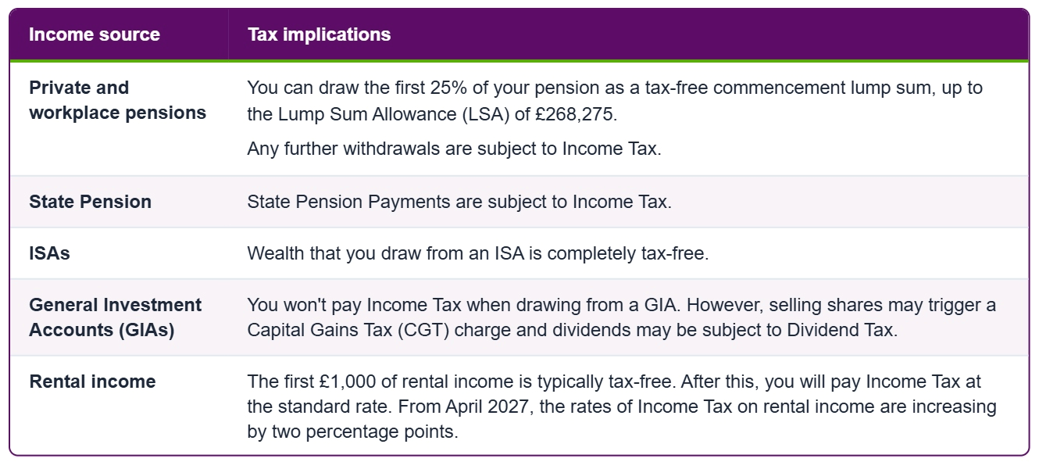
As you can see, your tax bill could vary significantly, depending on how you design your income. More importantly, with careful planning, you could limit the amount you pay.
For instance, if your annual expenses are £30,000 and you draw the full amount from your workplace pension, you would pay Income Tax on the remaining £17,430 after using your Personal Allowance. This assumes you’ve already used your 25% tax-free lump sum.
In comparison, if you took £15,000 from an ISA and £15,000 from your pension, only half of your income would be taxable. After applying the Personal Allowance, you’d only pay Income Tax on £2,430.
As you can see, this would make a marked difference to the amount of Income Tax you pay. We can review your savings and discuss the most tax-efficient way to generate an income.
Get in touch
It’s never too early to start planning your retirement income strategy. We are here to support you with this.
Please contact us at hello@ardentuk.com or call or WhatsApp us on 01904 655330 to learn more. As an award-winning financial advice company with advisers included in the 2025 VouchedFor Top Rated guide, we can assure you that we’re a bona fide company providing excellent advice and high-quality service.
Please note
This article is for general information only and does not constitute advice. The information is aimed at individuals only.
All information is correct at the time of writing and is subject to change in the future.
Please do not act based on anything you might read in this article. All contents are based on our understanding of HMRC legislation, which is subject to change.
The Financial Conduct Authority does not regulate tax planning or cashflow planning.
A pension is a long-term investment not normally accessible until 55 (57 from April 2028). The fund value may fluctuate and can go down, which would have an impact on the level of pension benefits available. Past performance is not a reliable indicator of future performance.
The tax implications of pension withdrawals will be based on your individual circumstances. Thresholds, percentage rates, and tax legislation may change in subsequent Finance Acts.