Prior to his first Budget, there were rumours that Chancellor John Healey would increase the rate of Capital Gains Tax (CGT). We now know these changes never materialised.
However, since 2023, governments have made several important amendments to CGT, which could mean you pay more when selling certain assets.
Read on to learn what’s changed and how you could potentially reduce your CGT bill.
The Annual Exempt Amount has fallen from £12,300 to £3,000 since April 2023
CGT is a tax on profits from selling qualifying assets, including stocks and shares, properties that aren’t your main home, valuable jewellery, or artwork.
Fortunately, you can make a certain amount each year before you start paying tax. This is your Annual Exempt Amount.
Before April 2023, the Annual Exempt Amount was £12,300, but the government reduced it to £6,000.
The following year, in April 2024, it halved to £3,000, where it currently stands.
This means that you’re far more likely to trigger a tax charge in the first place and a larger portion of your gains will be taxable.
According to HMRC estimates, the reduced Annual Exempt Amount brought another 163,000 people into the scope of CGT.
The rates of Capital Gains Tax increased in October 2024
As well as changes to the Annual Exempt Amount, the government adjusted the rates at which you pay CGT.
The higher rate for residential property fell from 28% to 24% in April 2024, but increases in October of the same year overshadowed this change.
The standard rates of CGT for basic-rate taxpayers rose from 10% to 18%, while higher- and additional-rate taxpayers saw an increase from 20% to 24%.
As such, if you do trigger a CGT charge, you’ll pay a higher rate than you would have done three years ago.
These changes have significantly affected the amount of Capital Gains Tax you pay
To understand how these CGT changes might affect you, it’s worth considering an example.
If you purchased some shares for £5,000 and later sold them for £20,000, you would make a profit of £15,000. The following table shows the difference in the amount of CGT you would pay before and after changes made in the past three years. The figures assume you are a higher-rate taxpayer and made no other taxable gains in that year.
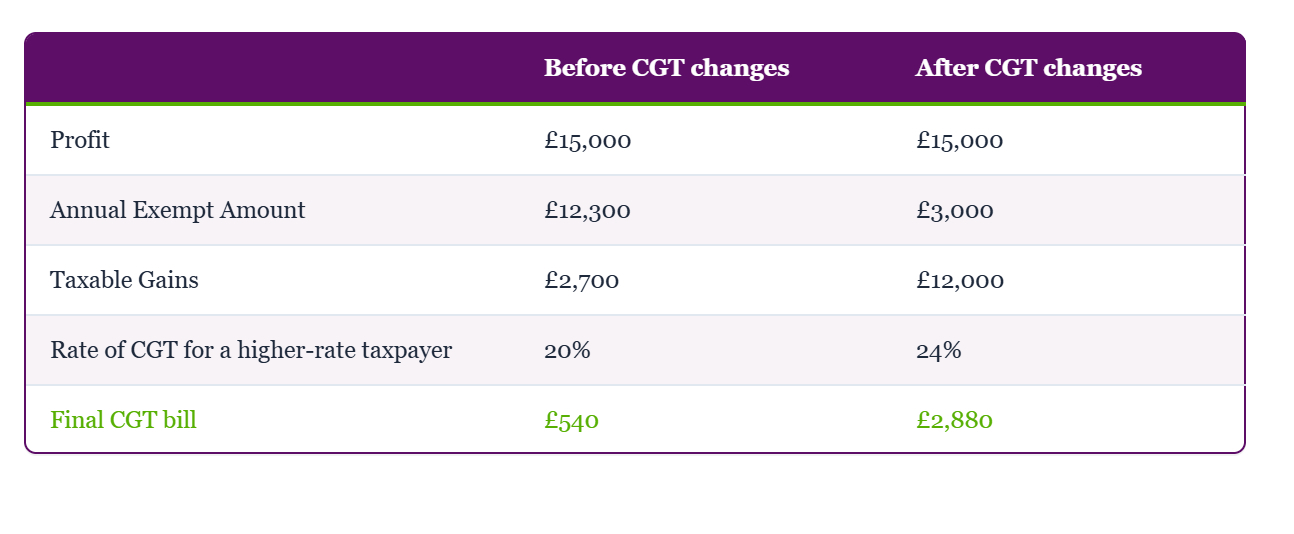 As you can see, the cumulative effect of the changes over the past three years means that the same transaction could cost you an additional £2,340 in CGT.
Fortunately, with careful planning and the right support, you may be able to reduce your tax liability.
4 ways to reduce the amount of Capital Gains Tax you pay
1. Only sell assets when necessary
Unless you remain within your Annual Exempt Amount, you could trigger a CGT charge, so before selling assets, consider whether it is necessary.
If you need to fund a specific goal, selling investments might be the most suitable course of action. In this case, we’ll work with you to manage the CGT you pay. However, if you don’t need the funds right away, it may be more tax-efficient to leave your investments and avoid a CGT charge. You might see more growth in the future, too.
Selling investments without a clear reason could mean you pay CGT, only for the funds to sit in a savings account for a period. Conversely, if you limit sales and time them carefully, you could reduce your tax burden.
2. Take advantage of your ISAs
When you invest through a Stocks and Shares ISA, there is no Dividend Tax or CGT to pay on your returns.
Read more: 2 tax wrappers to help you mitigate a large bill
As of 2026/27, you can contribute up to £20,000 across all your ISAs. Using as much of this allowance as possible before investing elsewhere could help you reduce CGT.
3. Make strategic use of your Annual Exempt Amount
If you do plan to sell investments, being strategic with your Annual Exempt Amount could help you reduce the amount of CGT you pay.
Your Annual Exempt Amount resets at the beginning of each tax year, so if it suits your goals, you could make multiple smaller sales across several tax years instead of one large disposal. This may allow you to stay within your Annual Exempt Amount, or at least reduce your taxable gains each year, to limit the CGT you pay.
4. Plan as a couple
The Annual Exempt Amount is an individual allowance, enabling couples to plan together.
You can pass assets to a spouse or civil partner if you are living together, and they won’t pay CGT. There may be some CGT to pay if they later sell the asset, and the potential profit will be calculated based on the price you paid for it and how much they sell it for.
Even so, splitting assets between you and selling them means you can benefit from both Annual Exempt Amounts. Also, if your partner is in a lower tax bracket than you, it may be more tax-efficient for them to sell the assets as they would pay a lower rate of CGT.
Get in touch
We can discuss these methods for reducing CGT, so you can generate a tax-efficient income from your investments.
Please contact us at hello@ardentuk.com or call or WhatsApp us on 01904 655 330. As an award-winning financial advice company with advisers included in the 2025 VouchedFor Top Rated guide, we can assure you that we’re a bona fide company providing excellent advice and high-quality service.
Please note
This article is for general information only and does not constitute advice. The information is aimed at individuals only.
All information is correct at the time of writing and is subject to change in the future.
Please do not act based on anything you might read in this article. All contents are based on our understanding of HMRC legislation, which is subject to change.
The Financial Conduct Authority does not regulate tax planning.
The value of your investments (and any income from them) can go down as well as up and you may not get back the full amount you invested. Past performance is not a reliable indicator of future performance.
Investments should be considered over the longer term and should fit in with your overall attitude to risk and financial circumstances.