Knowing where to invest your wealth can be challenging, especially as you have more options than ever.
The Financial Conduct Authority lists 29 individual product types on its investment dashboard. Within those different types of investment, there is incredible variability. For instance, if you invest in funds (which comprise a collection of stocks, shares, and bonds), there are thousands of options to choose from.
What’s more, your priorities will change over time, meaning certain investment types are more suited to you at different stages of life.
Everybody has unique financial goals and their own attitude to risk, and your investment strategy should be personal to you. However, there are key considerations to keep in mind at each stage of life to help guide your investment choices.
Short-term goals may take precedence earlier in life, but it’s always beneficial to start saving for the long term
You may not have focused on investing when you first entered adulthood and started your career, but the landscape is changing. More young people than ever are investing, and the Investment Association reports that:
- 33% of Generation Z already invest
- 20% of Generation Z said investing was a bigger priority than buying a house.
This means that your children or grandchildren may be starting their own investment journey and could look to you for guidance.
Short-term financial goals could be a priority at this stage of life
At any stage of life, it’s important to consider the investment timescale. For younger people in early adulthood, this often depends on why they’re investing.
For example, your children or grandchildren might want to build wealth to reach certain financial milestones, such as buying a home, getting married, or starting a family. In this case, they may focus on short- to medium-term saving and investment options that give them easier access to their wealth, including bonds or fixed-term Cash ISAs.
That way, they can lock the funds away for a few years and secure a higher interest rate but still withdraw the funds when they need them.
It’s never too early to start investing for the long term
Although younger people often have short- or medium-term goals, they may want to begin contributing small amounts to long-term investments, even at this early stage of life.
The wealth in pensions or a Stocks and Shares ISA may benefit from compound growth over time. Even small contributions now can make all the difference later, so it could be beneficial to start as early as possible.
Mid-life could be the ideal time to adopt more risk and take a long-term approach to investing
As you approach the middle part of your life, you may have reached early goals such as buying a property or building an emergency fund. Your earnings could increase as you progress in your career, too.
At this stage, you may turn your focus to your long-term strategy, considering how to build lasting financial security and fund your eventual retirement.
Investing in the stock market could bring greater returns, but the timescale is important
Historical data shows us that the stock market typically delivers higher growth than cash or low-risk investments, such as bonds. More importantly, inflation erodes the value of cash, meaning the real-terms growth is lower than you might realise.
For example, figures from Vanguard show that if you saved £10,000 in cash at the end of 2004, it would have grown to approximately £15,600 by the end of 2025 (based on average cash returns). However, accounting for inflation, the real-terms value would be closer to £4,100 – a loss of 59%.
Meanwhile, if you invested the same amount in the FTSE All-World Index (an index comprising large and mid-sized companies around the globe) for the same period, it would be worth about £86,400, or £74,000 after inflation. That’s 640% growth.
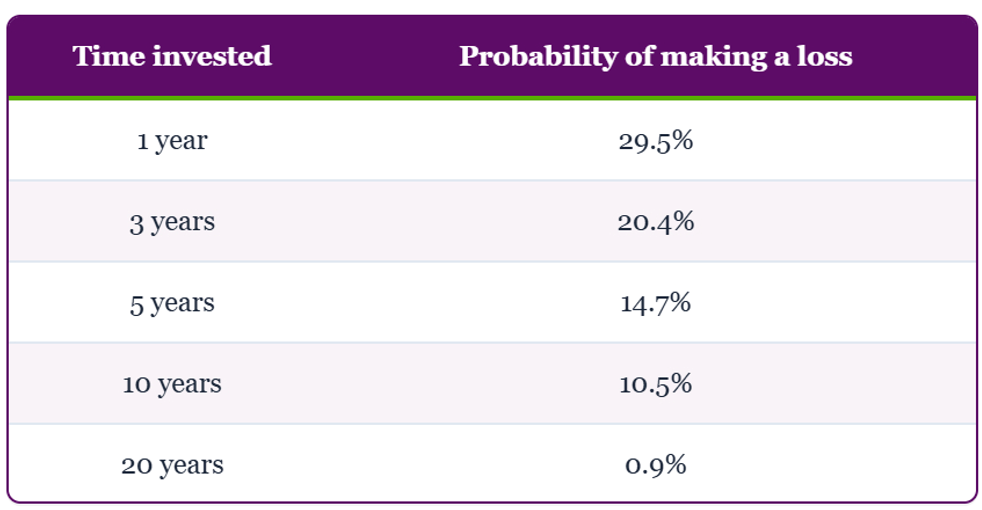
Additionally, your chances of making a loss on the stock market decrease the longer you hold your investments.
The following table shows the performance of a portfolio with 60% invested in the S&P 500 and 40% invested in US government bonds. The data measures any given rolling period between January 1871 and December 2025 and considers the chances of making a loss, depending on how long you hold your investments.
Source: BlackRock
As you can see, if you hold investments for 10 or 20 years, your chances of making a loss are reduced significantly. Yet, if you were to hold your investments for only a few years, you would have a much greater chance of negative returns.
That’s why earlier in life, when you are building wealth for short-term goals, you might focus on low-risk options. Then, as you establish a financial base and start building wealth for the long term, you can increase contributions to stock market investments.
You may consider increasing contributions to your pension at this stage of life
Hopefully, you’ve already started building your pension but now you may consider increasing contributions. Paying into a pension has several distinct advantages:
- You benefit from tax relief on your contributions.
- Your employer will likely contribute, too.
- The savings are invested and could grow significantly.
However, bear in mind that you can’t normally access your pension savings until you’re 55 (rising to 57 from April 2028).
If you plan to retire before you can access your pensions, you may need to rely on other savings and investments to fund your lifestyle for a period. You will need to factor this into your investment strategy.
You may need to adapt your investment strategy as you transition to retirement
As you approach retirement and consider drawing an income from your investments, you may need to adapt your approach.
If the stock market dips as you begin accessing your investments, you will need to cash in a greater portion of your portfolio to generate the necessary income to fund your lifestyle. This could mean you deplete your pot faster.
Moving to lower-risk options can reduce the chances of this happening, potentially making it easier to balance withdrawals and make your savings last. You might consider this when managing your pensions and other investments.
That said, as life expectancies increase, you may need to fund yourself in retirement for 20 or 30 years. That’s why your portfolio must continue growing throughout your retirement, so it lasts the rest of your life.
This is a difficult balance as you need to manage risk while also generating adequate growth to make your retirement pot sustainable. We can support you with this.
Get in touch
Whether you want to help your children or grandchildren get started, build wealth in mid-life, or balance your investments during retirement, we can help you develop a strategy that works for you.
Please contact us at hello@ardentuk.com or call or WhatsApp us on 01904 655330. As an award-winning financial advice company with advisers included in the 2025 VouchedFor Top Rated guide, we can assure you that we’re a bona fide company providing excellent advice and high-quality service.
Please note
This article is for general information only and does not constitute advice. The information is aimed at individuals only.
All information is correct at the time of writing and is subject to change in the future.
A pension is a long-term investment not normally accessible until 55 (57 from April 2028). The fund value may fluctuate and can go down, which would have an impact on the level of pension benefits available.
The tax implications of pension withdrawals will be based on your individual circumstances. Thresholds, percentage rates, and tax legislation may change in subsequent Finance Acts.
The value of your investments (and any income from them) can go down as well as up and you may not get back the full amount you invested. Past performance is not a reliable indicator of future performance.
Investments should be considered over the longer term and should fit in with your overall attitude to risk and financial circumstances.